Guide
UGC Ad Hooks: Three Openings for the Same Product
UGC ad hooks are the opening words, visuals and sounds that give someone a reason to keep watching a creator-style ad. A useful hook points toward the product demonstration that follows. It should not make a promise the rest of the video cannot answer.
This guide pairs Renoise's published Three ad hooks preview with three generated English openings for one example product. You will see what changes between a problem-led opening, a direct demonstration and a curiosity-led detail—and how to compare openings without changing the whole ad.
Watch how one product supports three creative directions
The left column uses a young creator with chrome lettering and pastel graphics. The middle column places an older storyteller inside a newspaper layout. The right column uses a tea-bag mascot, saturated primary colors and bouncing sticker type.
Each direction also changes the pitch: a question, a story and a mascot demonstration. Product preparation footage appears within the layouts. Notice how the graphics introduce a second view of the product while the presenter remains on screen.
The preview is useful for choosing a creative direction. It cannot tell you whether the wording, the presenter or the graphic style caused a response, because several things change together. Its highlighted column rotates through the three directions; that highlight does not mark a winning ad.
Design the opening around what the viewer can see
A hook has three parts you can brief separately:
| Part | Question to answer | Example |
|---|---|---|
| First image | What is already happening when the video starts? | A hand searches a crowded work bag |
| First line | What specific reason does the viewer have to watch? | “Packing for the day?” |
| Payoff | What does the next shot resolve or demonstrate? | A bottle is filled, closed and placed in the side pocket |
TikTok recommends a hook, body and close structure for its video ads.1 Treat the opening as the beginning of that sequence. A surprising cut that has nothing to do with the product may attract a glance without helping the viewer understand the offer.
Write the body before polishing ten opening lines. Once you know what the ad can actually demonstrate, it becomes easier to choose a question it can answer. If the body only shows packaging, an opening about long-term results asks too much of the footage.
Three UGC ad hooks for the same product
We generated three openings for a fictional orange reusable bottle with a screw cap and carry loop. The intended viewer is packing a work bag. The product facts are limited to those visible features; there are no cooling-duration, leakproof or health claims.
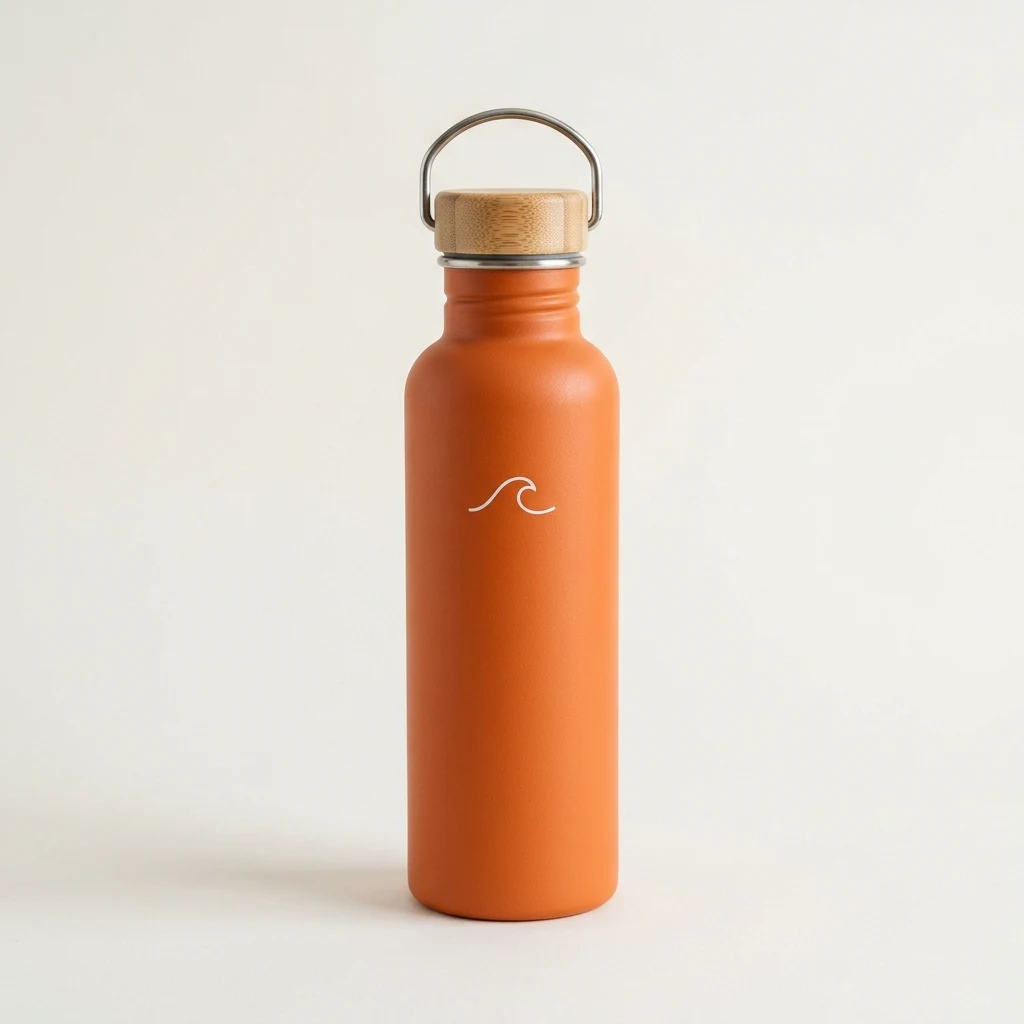
These are generated editorial examples with original English audio, not excerpts from the tea preview or ads with measured performance. Every task received the same bottle and fictional adult presenter references. Each final edit has a different four-second opening followed by the same eight-second body and closing instruction: “See the bottle and its details.”
1. Problem-led: show the situation before the product
Opening line: “Packing for the day? Don't leave your water behind.”
Shot brief: The presenter finishes placing a notebook in a work bag. The bottle is still on the counter beside it. The presenter notices it and reaches over.
Caption: The complete opening line remains visible throughout the four-second opening.
Handoff to the body: Cut to the product-detail image, then return to the common shot of the bottle being lifted and placed in the bag.
This opening is about a recognizable routine. The image carries the situation before the line explains it. Keep the setup short: a lengthy search through the bag would delay the actual demonstration.
Choose this approach when the product fits a moment the audience recognizes. Keep the problem proportionate. A reusable bottle can belong in a morning routine without being described as a solution to fatigue or another unsupported outcome.
2. Demo-led: begin with the useful action
Opening line: “Fill it, close it, take it with you.”
Shot brief: Start close on the open bottle as it is filled. The next action is the screw cap turning into place. Show the carry loop clearly during the pickup.
Caption: The opening line appears in two short lines below the product action.
Handoff to the body: Insert the cap-and-loop detail before the shared packing shot, so the closing action is not immediately repeated.
The demonstration is the invitation to watch. It needs clear framing and believable handling more than a dramatic transition. Keep the cap visible; a hand covering the whole mechanism would remove the useful detail.
This direction suits products whose operation can be understood quickly. If a generated action looks physically wrong, use real footage for that action or simplify the shot. Editing cannot make a visibly broken mechanism into reliable product evidence.
3. Curiosity-led: reveal the context of a detail
Opening line: “What's the last thing going in your work bag?”
Shot brief: A tight view shows the carry loop in the presenter's hand. Pull back enough to reveal the bottle and the open bag.
Caption: The opening question remains visible during the reveal.
Handoff to the body: Use the same detail insert and packing shot. The reveal answers the opening question before the common explanation begins.
The detail creates a small information gap. Keep it connected to the actual product. Hiding the item behind abstract flashes for several seconds would turn a practical ad into a guessing game.
Use this approach when a distinctive part of the product can introduce it. Give the viewer a clear reveal rather than saving all useful information for the final frame.
What the generated comparison actually shows
The opening concepts are visibly different, but the references did not lock every part of the scene. In A and C, the bag sits to the viewer's right; in B and the common body it is to the left. Framing, posture and background also vary. These are useful examples of three opening ideas, not a clean opening-only performance test.
A second issue appears at the edit. The openings finish with a closed bottle, while the generated body starts with it open. Placing the clips directly together would reset the action. We covered the body's first 3.7 seconds with the generated cap-and-loop still, retaining its original narration, then resumed the packing footage. The identical eight-second body is encoded once and reused in all three versions.
The insert makes that a deliberate cutaway; it does not make independently generated scenes a single continuous take. Before running a controlled ad test, match the bag placement and camera framing, review the voices together, and inspect the cap and loop at full size. The detail-reveal opening also seats the cap without a visible screw turn, so it should not be treated as a precise demonstration of the closure.
Production record: Wan 3.0 generated three four-second openings and one eight-second body at native 720 × 1280, with English audio. Those four source clips cost 240 credits on November 17, 2026. Three additional product stills cost 30 credits, bringing the complete image-and-video batch to 270. The campaign workflow shows the stills. Captions and the cutaway were added locally; no extra video generation was used for the edits.
Independent audio analysis identified all four requested spoken lines. Frame review covered the four source clips at five frames per second, including the cap and bag handling. That is bounded production evidence, not a continuous listening or human approval claim. No paid campaign has been run, so there is no winning hook to report.
Keep one body and one closing instruction
For a focused comparison, use one approved video body after each opening. The bottle, presenter, setting, voice, captions, offer and closing instruction should remain consistent. Plan each opening to reach a matching handoff frame, then check the join at normal speed.
| Segment | Keep fixed | What can differ |
|---|---|---|
| Opening | Product, presenter, setting, intended audience | First action, first line and matching caption |
| Main demonstration | Exact approved footage and sound | Nothing in an opening-only comparison |
| Closing frame | Offer, destination and CTA | Nothing in an opening-only comparison |
| Distribution | Comparable audience, placement and measurement | The creative variant being evaluated |
An editorial comparison still has limitations. Changing the first line can change delivery time and the action needed to support it. Record those differences instead of calling the experiment perfectly isolated.
Xyla's guide also recommends keeping the main ad and changing the beginning when testing openings.2 Its organic-post statistics are not evidence that any of these three scripts will improve paid-ad results.
How to brief Renoise for hook variations
Supply the product photo, approved facts, audience, language, presenter reference and a clear list of invariants. If you use a real person's likeness, supply an authorized reference. For an AI presenter, describe the role and delivery without inventing a customer's history.
For broad exploration, use Three ad hooks and choose the presenters and looks you want to compare. Its default design deliberately gives each opening a distinct treatment. For a fixed-presenter exercise, say explicitly that all three should use the same person and visual style.
A useful instruction names the change: “Create a problem-led opening, a demo-led opening and a detail-reveal opening for this bottle. Keep the same presenter, lighting and product reference. Each opening must lead into the attached approved body.” Check the resulting footage before assuming the model preserved those constraints.
For the full creator-style ad workflow, see the AI UGC video guide. If you need to plan images, videos and channel versions together, use the small-business AI marketing workflow.
Review speech, product handling and the join
Watch the openings once without sound. Is the situation or action understandable? Then listen without looking at the screen. Does the first line sound like something a person would say, and does it finish before the cut?
Check the full versions together afterward. Look for a sudden change in voice, a product that switches hands between shots, a caption that appears too early, or background music that restarts at the join. These distractions can make the variants feel different for reasons unrelated to the opening idea.
Keep the claims literal. An AI presenter can explain visible features or perform a scripted demonstration. “I've used this every day for a month” implies personal experience; do not add it because it sounds conversational. Use genuine, approved testimony only when you have it.
Decide what to measure before calling a hook better
Creative review can tell you which version is clearer, more coherent or more natural. Paid-media testing can tell you how the versions performed under a particular distribution setup. Record those as separate findings.
Use consistent definitions for impressions, early views, longer views, clicks and the business outcome you care about. Platform metrics differ, so do not compare two “hook rates” until you have checked their numerator and denominator. A high early-view rate alone does not establish a useful result for the business.
Keep a simple log: variant name, opening line, shot, presenter, changed elements, launch dates, placement, spend and outcome. If volume is too low to distinguish the variants, keep the result inconclusive. The next useful experiment may be a clearer product demonstration rather than another attention-grabbing sentence.
Sources
- TikTok: Creative best practices, accessed November 17, 2026. Structure guidance; no performance benchmarks reproduced.
- Xyla: Ad hooks for product brands, accessed November 17, 2026. Used for the distinction between changing an opening and changing the whole ad.
- Renoise public template catalog, checked November 17, 2026. Published Three ad hooks preview and template entry.