Industry
Niulai, Explained: How a Mocked Animated Film Became a Remix Engine
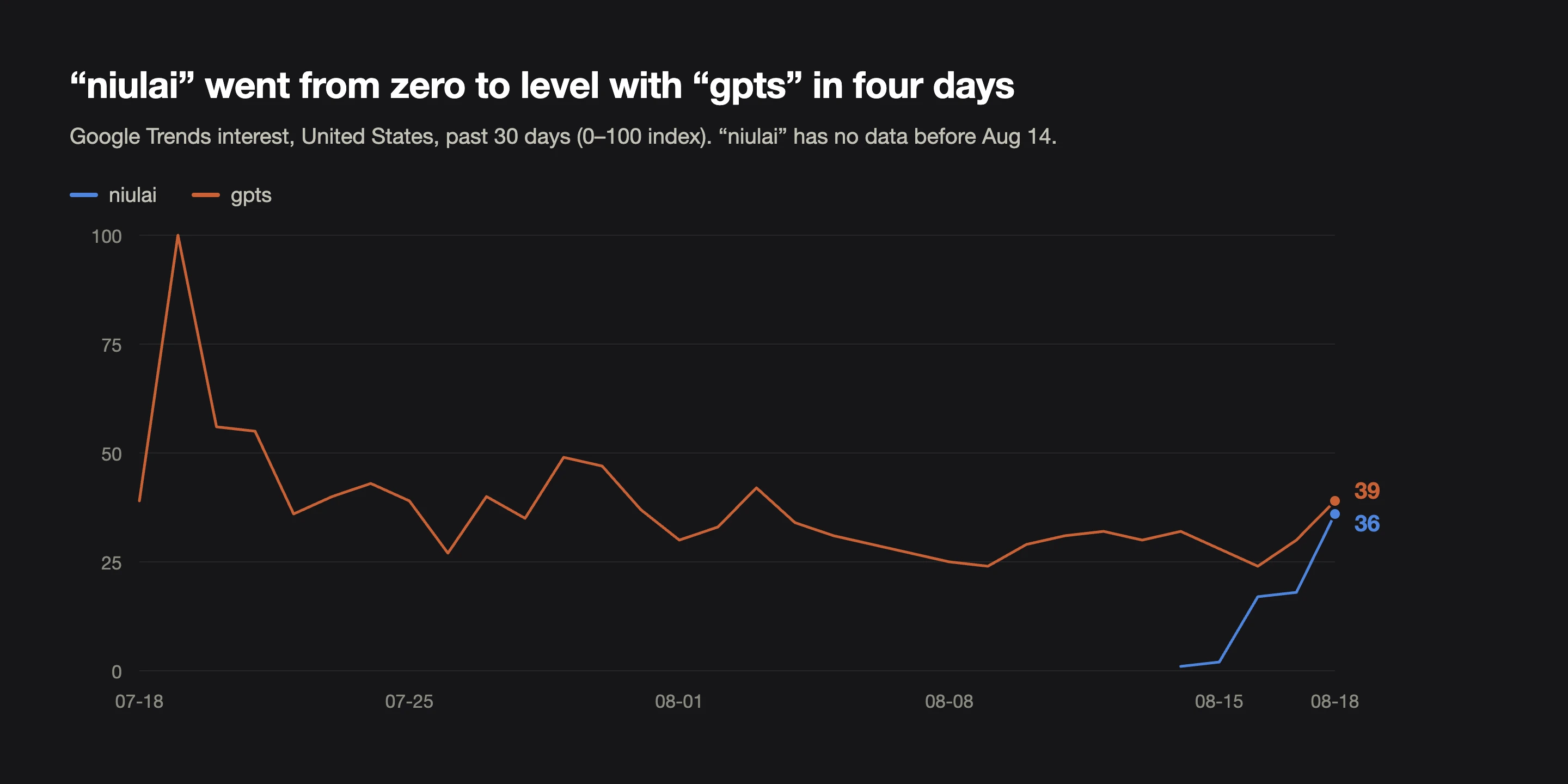
On August 5, 2026, a Chinese 3D animated film called Niulai (牛来 — often written Niu Lai in English coverage) opened in theaters and almost nobody went. Over its first nine days it took about 7,169 yuan — roughly a thousand US dollars, or the price of a used scooter. Then the internet found it. Within four days the same film had crossed 17 million yuan (about $2.5 million) and was sitting in China's box-office top ten.[1] The reason is not a marketing story, and it is not really a film-quality story either. It is a story about how a piece of media becomes raw material.
What Niulai actually is
The facts are unusually small for something this loud.
| Release | August 5, 2026 (China) |
| Title | 牛来 — literally "the bull is coming" |
| Made by | Director Xin Yumeng together with Sun Lifan, the director's mother, over five years[1] |
| First nine days | |
| One Monday, mid-August | 8.2 million yuan (~$1.2M), ~300,000 admissions[1] |
| Cumulative by Aug 18 |
It is a dream-and-growing-up story about a calf and a lark, rendered in rudimentary 3D. One promotional image was a calf hand-drawn in pen, without color. Viewers on Douban called the character models ugly and eerie, and the reviews were savage enough to become the actual advertisement.[1]
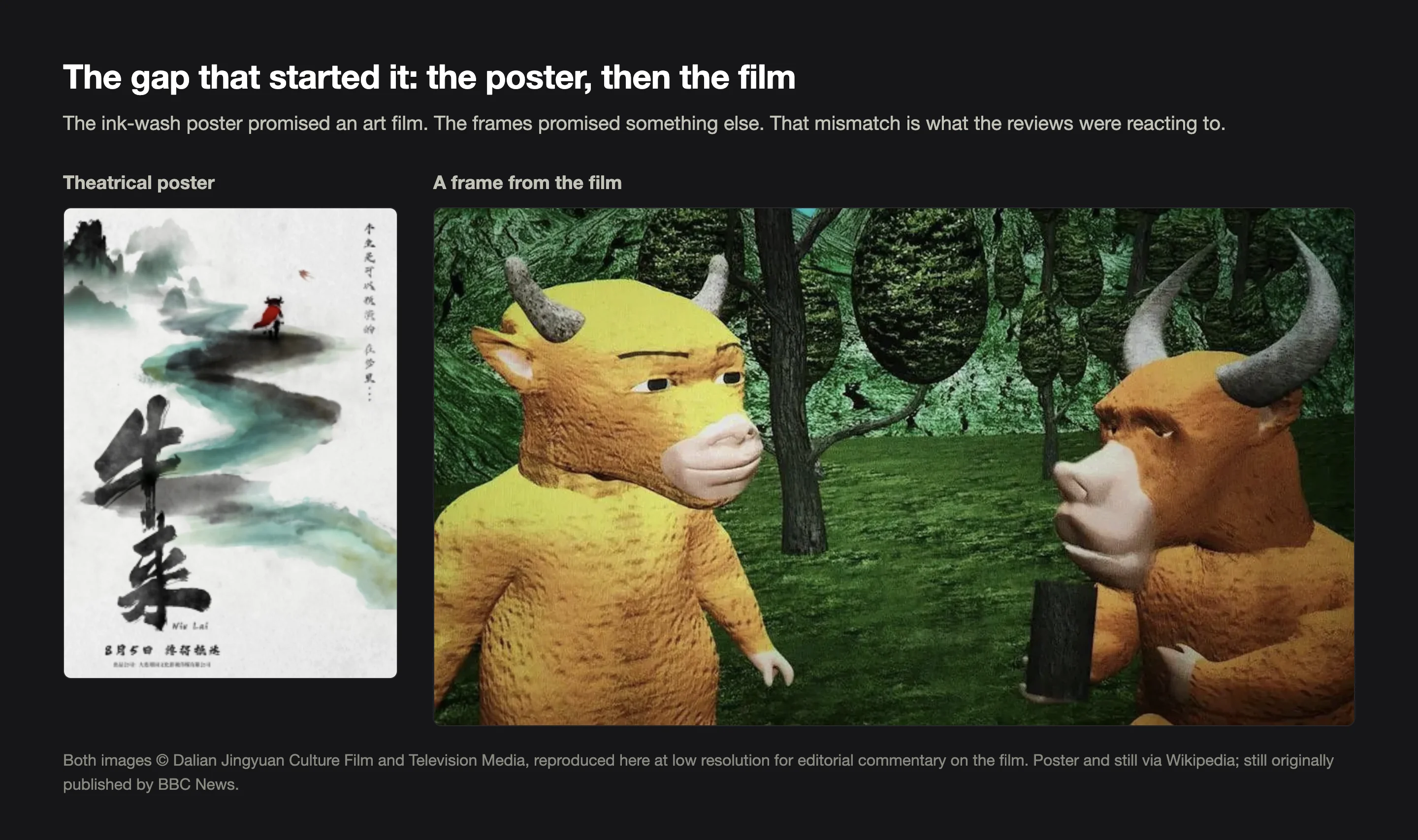
Two people made it over five years. That detail matters for everything below, so it is worth stating plainly before the remixes: this was hand work, and the people who did it are the reason there is anything to remix.
Why it went viral: the recommendation was the joke
The mechanism was ironic recommendation. People bought tickets because the reviews were brutal — to see how bad it really was, to drag a friend in as a prank, to be in the room when the theater laughed. Comments circulated like "unbelievably terrible and eye-opening." Wire coverage compared the dynamic to the American "six-seven" craze: absurd content pulled in an audience on meme potential rather than quality.[1]
Two accelerants stacked on top:
- The title is a market pun. 牛来 reads as "the bull is coming," which in Chinese is what you say about a bull market. That handed finance-meme accounts a mascot for free.
- A same-name token. A meme coin borrowing the name launched on BNB Chain on August 14 and spiked hard, which dragged crypto attention into the same search term.[2] Worth flagging as a separate thing entirely: it has no connection to the film's makers.
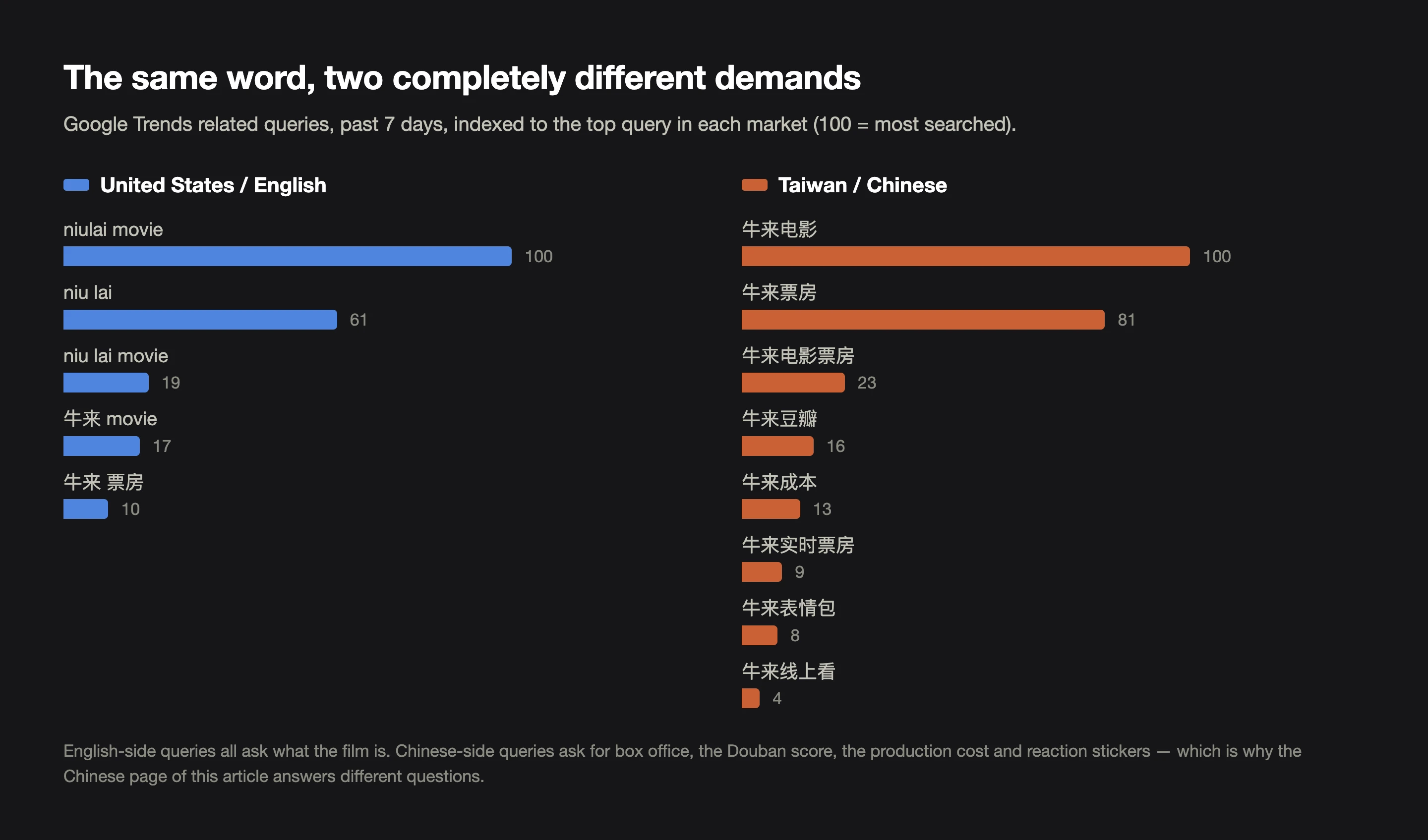
By August 18 the film had reportedly been pulled from some theaters, including in the production company's home city.[2] The remixes did not slow down.
The eight remix formats
This is the part that is genuinely interesting, and the part almost nobody has written down.
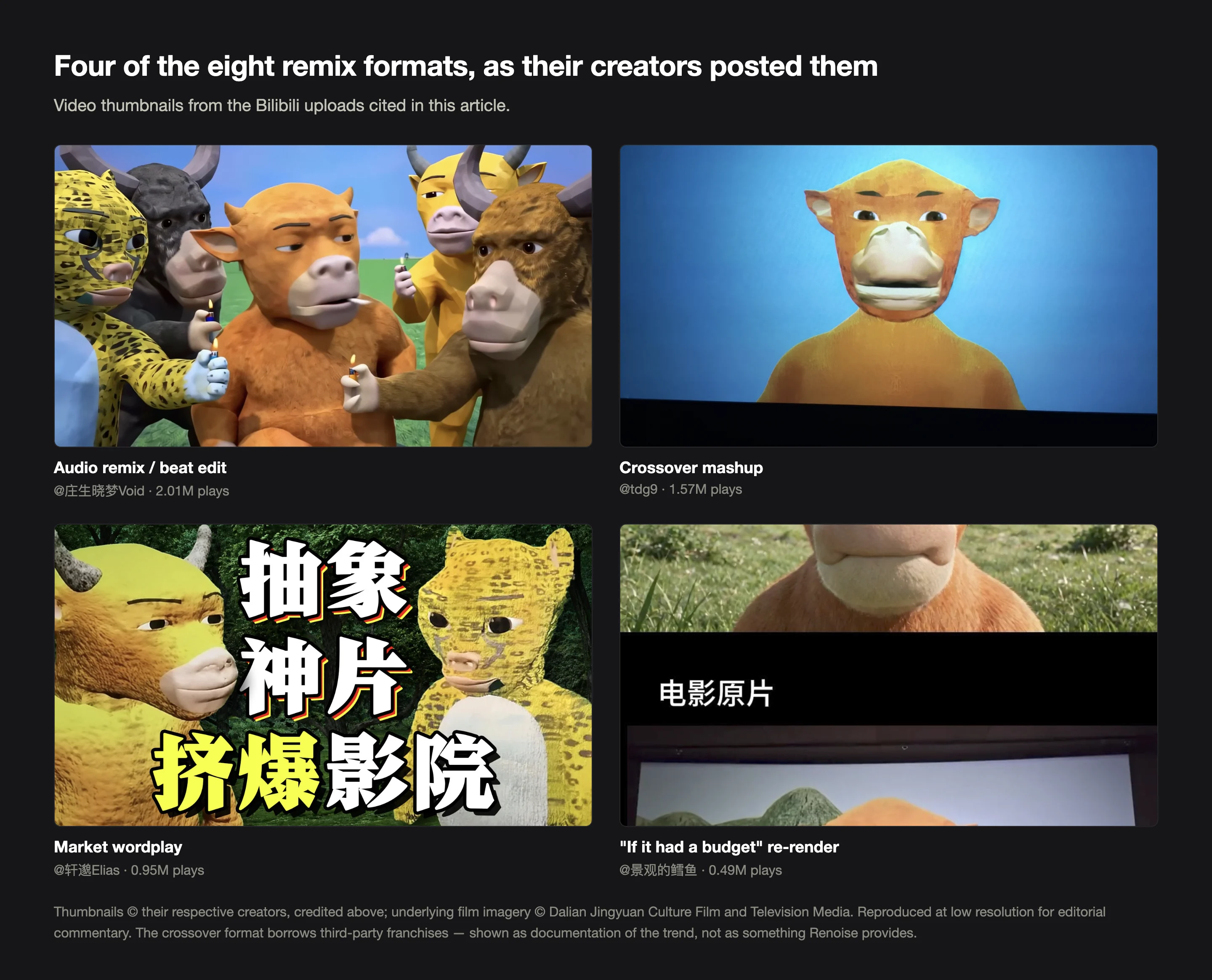
Sorted by how much attention each format actually pulled on Bilibili:[3]
| Format | What people do | Example scale |
|---|---|---|
| Audio remix / rhythm edits | Re-cut footage to a beat; jumpstyle, hardstyle, pop covers | 2.0M plays |
| Crossover mashups | Drop the calf into another franchise's plot and title | 1.6M plays |
| Real-or-fake guessing | Home-made shots in the film's style, passed off as the real cut | 1.5M plays |
| Market wordplay | Recut around "the bull is coming"; posters redrawn as candlestick charts | 1.2M plays |
| Theater-reaction clips | Film the audience, not the screen | 790K plays |
| AI song remakes | Original tracks written about the film, generated end to end | 506K plays |
| "If it had a budget" | Re-render a rough shot at cinematic quality, side by side with the original | 489K plays |
| Reaction templates | Freeze-frames as reaction images — one fan site catalogued 32 of them | 32 templates |
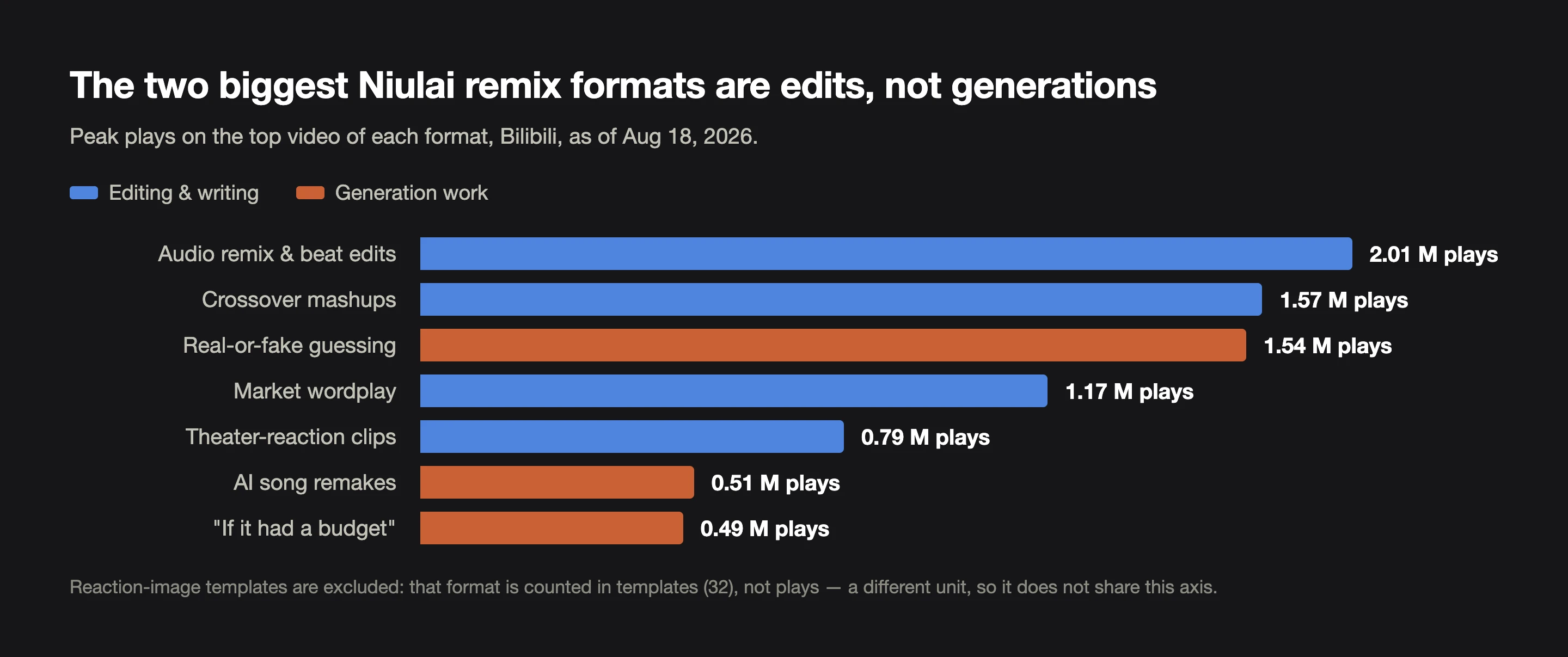
A pattern worth naming: only three of the eight formats are generation work, and the two biggest are not among them. Audio remixes, crossovers, market wordplay and theater-reaction clips are editing, timing and writing — human craft with ordinary tools. The internet's best remix work is still mostly cutting, not prompting.
Which formats are AI work — honestly
Three are, and it is worth being precise about which, because the difference is the whole point.
"If it had a budget" re-renders. Someone takes a rough shot and produces a version at the quality the story was reaching for. This is image-to-video plus upscaling. It is the format with the clearest craft ceiling, and notably it is the affectionate one — the framing is "this deserved more," not "this is bad."
Same-style shot generation. The real-or-fake format needs new footage that matches an existing visual language closely enough to fool people who have seen the film. That is a style-consistency problem, and it is hard in an interesting way.
AI song remakes are the third, and they are the one we should be straight about not covering. Those are whole songs with vocals, generated end to end. Renoise's audio side is not that: Lyria-clip produces 30-second instrumental backing, no vocals. Naming a capability we do not have would be the easiest thing in this article to get wrong.
The remaining five are out of scope for a generation tool, and pretending otherwise would be a stretch. Audio remixes are editing. Theater-reaction clips are a phone. Reaction templates are text on a freeze-frame — the fan site that catalogued them does it with no AI at all, which is the correct engineering choice for that job.
What this looks like in practice
If you wanted to make the "if it had a budget" version of a shot, the mechanics today are concrete:
- Start from a frame, not a prompt. ByteDance's Seedance 2.0 takes up to 9 image references plus 3 video clips and 3 audio tracks in one job, and supports first/last-frame control — so you pin what the shot must start and end on rather than describing it. It runs 4–15 seconds at 720p, 1080p or native 4K, across six aspect ratios. See Seedance 2.0.
- Hold the character across shots. Kling 3.0 Omni (built by Kuaishou) does multi-subject consistency and can generate up to 6 shots in one storyboard job, so a short sequence comes out coherent instead of assembled from unrelated clips. See Kling 3.0 Omni.
- Raise resolution after the fact. Renoise's upscaler enlarges existing images and video to 1080p, 2K or 4K as a post-process. Useful and cheap, and worth being straight about: an upscaled 4K file is not the same thing as a native 4K generation. Different quality ceilings.
- Expect review, not one-shot output. Consistency across a generation is a real improvement at the model layer, not a guarantee — long or crowded shots still drift. Budget iterations.
All of this lives in one AI video workspace, which matters here mostly because remix cycles are measured in days. If picking a model means switching subscriptions, you have already missed the wave.
Two things not to do
Worth saying out loud, because the highest-performing format is also the one you should not build on.
Crossovers are someone else's IP. The mashup format leads the view counts, and every entry in it borrows a franchise that belongs to a studio. Enjoy them; do not ship them as a product, a template, or a brand post.
Do not punch down at the makers. The film's own public identity, by August, was that it was made by hand with no AI at all — cinema staff were hand-painting posters because there had been no marketing budget, and the affectionate joke among fans was that it looked "worse than AI."[4] An AI company arriving to announce it could have done better is the least interesting thing available. The reason there is a remix engine here is that two people spent five years making something strange enough to be worth remixing.
[1]: Associated Press, "A Chinese animated film mocked as 'terrible' becomes a box-office hit" — https://www.clickorlando.com/entertainment/2026/08/18/a-chinese-animated-film-mocked-as-terrible-becomes-a-box-office-hit/ (accessed 2026-08-18)
[2]: KuCoin News, "Chinese animated film 'Niulai' faces partial theatrical removal, meme coin 'Niulai' surges on BNB Chain" — https://www.kucoin.com/news/flash/chinese-animation-film-niulai-faces-partial-theatrical-removal-meme-coin-niulai-surges-on-bnb-chain (accessed 2026-08-18)
[3]: Bilibili search results for 牛来 sorted by play count (accessed 2026-08-18). Figures are per-video play counts on the highest-performing example of each format, rounded.
[4]: Public posts on X carrying the film's hand-painted-poster and no-AI framing, mid-August 2026 (accessed 2026-08-18).